
Central Market Hall Budapest: What to Buy and Eat
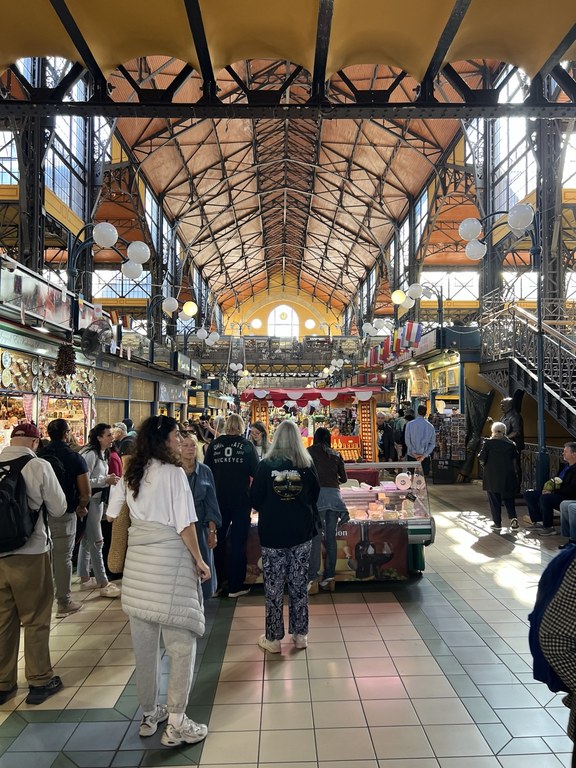
Central Market Hall is where we would start a food-shopping trip in Budapest: paprika powders and pepper pastes, thick white-coated winter salami, hanging strings of kolbász and bakery counters filled with curved pastries. Beside Corvinus University, the market brings the ingredients of Hungarian cooking together under a roof that deserves a look of its own.
On our September 2026 visit, we kept getting distracted. We would stop to read a sausage label, spot something at the next counter and wander over before finishing the first display. Our advice is to leave room in your schedule as well as your shopping bag.
This guide covers what caught our eye, the pork cracklings we tasted, two prices recorded during our visit and nearby places where we ate. For meals across the city, see our Budapest food guide.
What to buy at Central Market Hall: a quick guide
| Product | What to look for | Before buying |
|---|---|---|
| Paprika | Sweet or hot powder; pepper pastes in jars and tubes | Compare heat level, ingredients and pack weight |
| Winter salami | Téliszalámi, including the Pick products we photographed | Check the price per piece and the net weight |
| Kolbász and other charcuterie | Paprika sausages and products labeled with different meats | Read the full ingredient list and storage instructions |
| Tepertő | Pork cracklings, plain or paprika-coated | Start with a small portion; we found them very rich |
| Bakery products | Poppy-seed pastries and filled varieties | Read the filling labels before choosing |
Paprika: our first shelf to browse
Before choosing a tin or tube, read our Hungarian paprika guide for sweet and hot powders, smoked paprika and the pepper pastes you will see on these shelves.
If we were choosing one ingredient to bring back to our kitchen, we would head for the paprika shelves. Here, pepper comes as fine powder, thick paste, cream and sauce, with sweet and hot versions sitting close together. It makes the importance of paprika in Hungarian cooking immediately visible.
For powder, look for sweet or édes if you want the sweet variety; hot, csípős or erős can indicate heat. With jars and tubes, read the ingredients as well as the front label: a pepper paste is a different purchase from a packet of ground paprika.
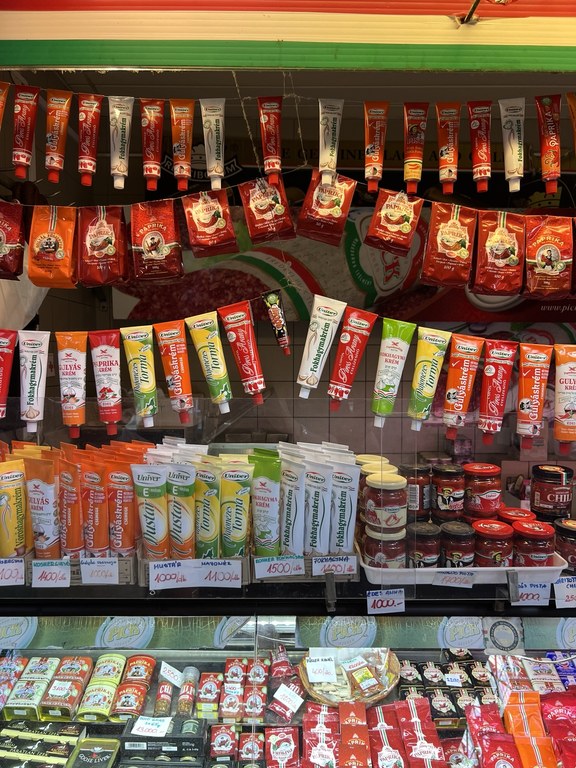
Some packages carried Great Taste award labels. Those caught our attention, but we would still choose according to the product itself, its heat and what we planned to cook. Our guide to what to eat in Hungary explains where paprika fits into the dishes you will meet on restaurant menus.
Winter salami: look for téliszalámi
Our Hungarian winter salami guide explains the name, the white coating and what to check on the wrapper before choosing a piece.
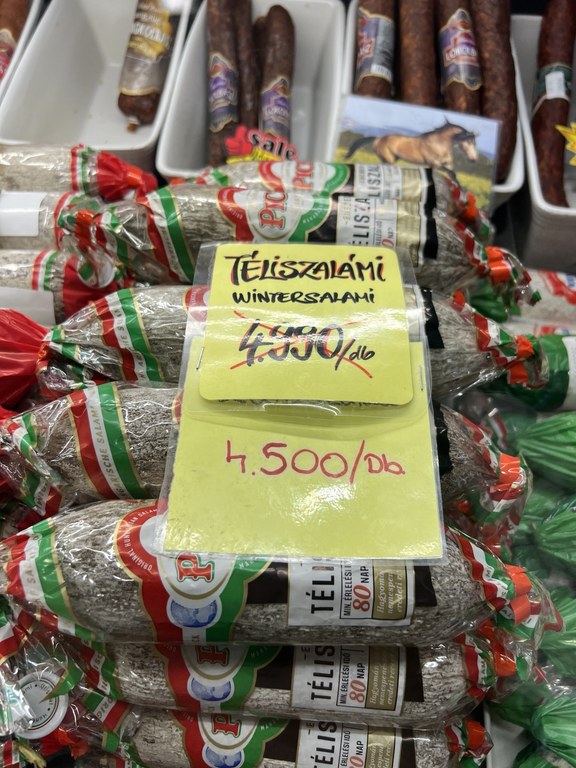
The thick salamis with white outer coatings are hard to miss. At the counter we photographed, packaged Pick products were labeled téliszalámi, or winter salami. Their pale surface stands out among the red-brown sausages around them.
Check the weight before comparing prices. A price for one salami tells you little about value until you know how much is in the package. The label we recorded showed 4,500 HUF per piece; we did not record a verified net weight, so there is no useful price-per-kilogram calculation to make from that photograph alone.
Kolbász and the charcuterie counters
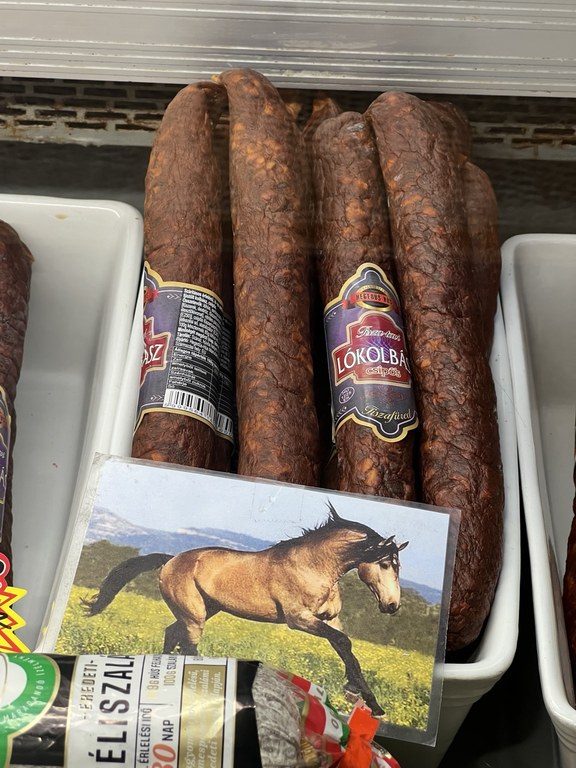
We could have spent a long time just looking at the hanging sausages: thin and thick, straight and curved, with different paprika and heat options. Kolbász and salami appear side by side, but they are distinct products, so it helps to read beyond the broad English word “sausage.”
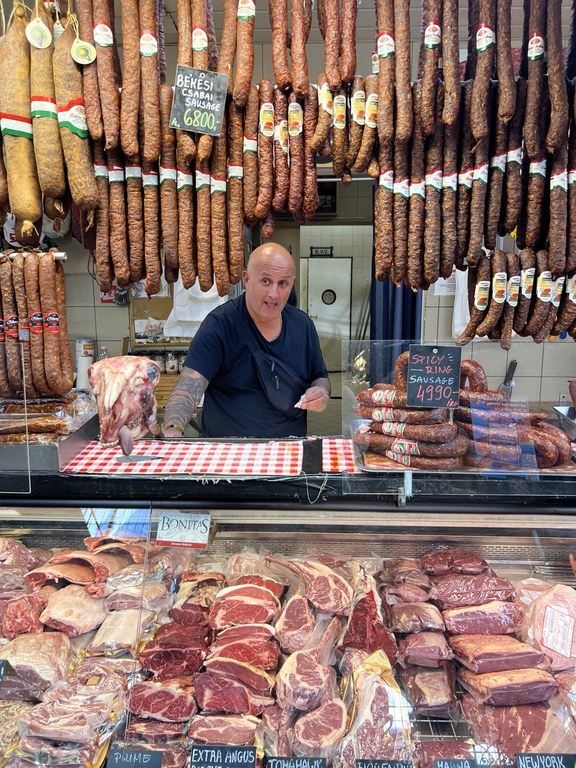
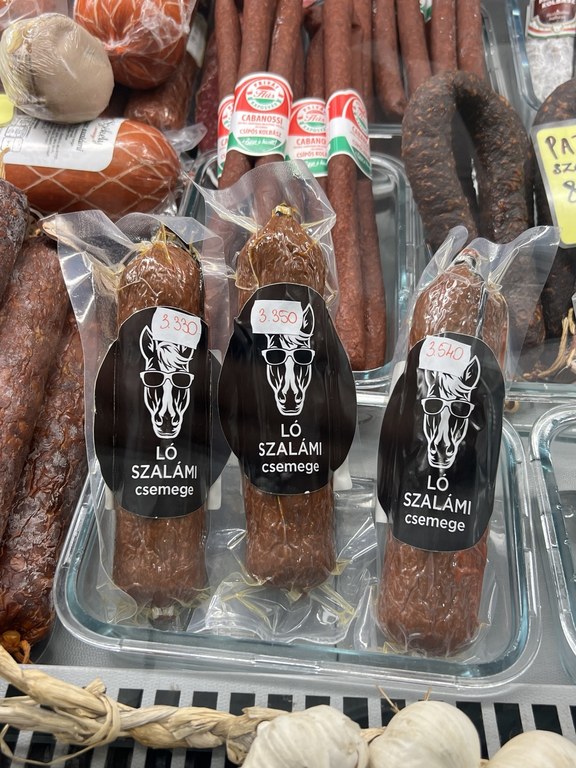
Horse, rabbit, deer and wild-boar products caught our eye among the counters we browsed. Our photographs show the difference between lókolbász, horse-meat sausage, and ló szalámi, horse salami. A named meat on the front label does not necessarily mean that it is the only meat in the mixture; check the full ingredients when choosing.
Tepertő: the pork cracklings we tried
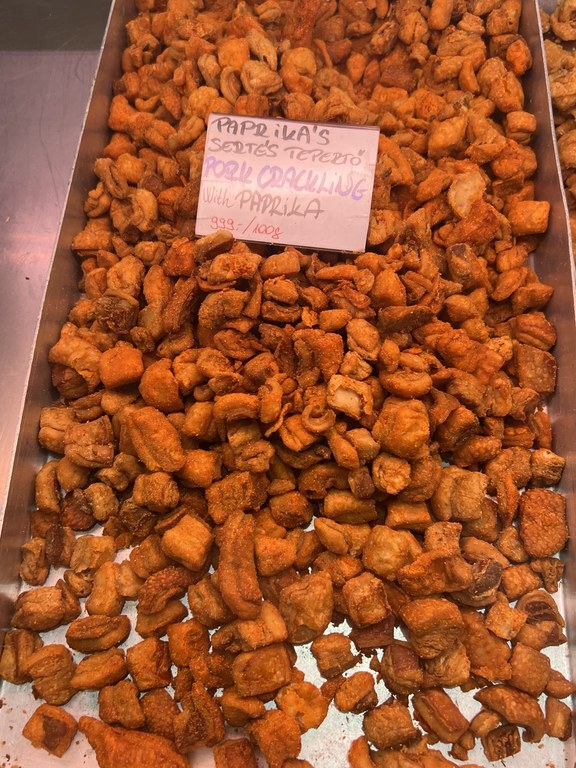
Among all the packaged foods, piles of crisp pork pieces invite a more immediate purchase. We saw plain tepertő and an orange-red paprika-coated version, the latter also labeled “Pork crackling with paprika.”
We bought 100 grams of pork cracklings, and even that felt like plenty. The crunch was there, but the fatty mouthfeel became heavy and repetitive as we ate. What we wanted most was something sharp to cut through it.
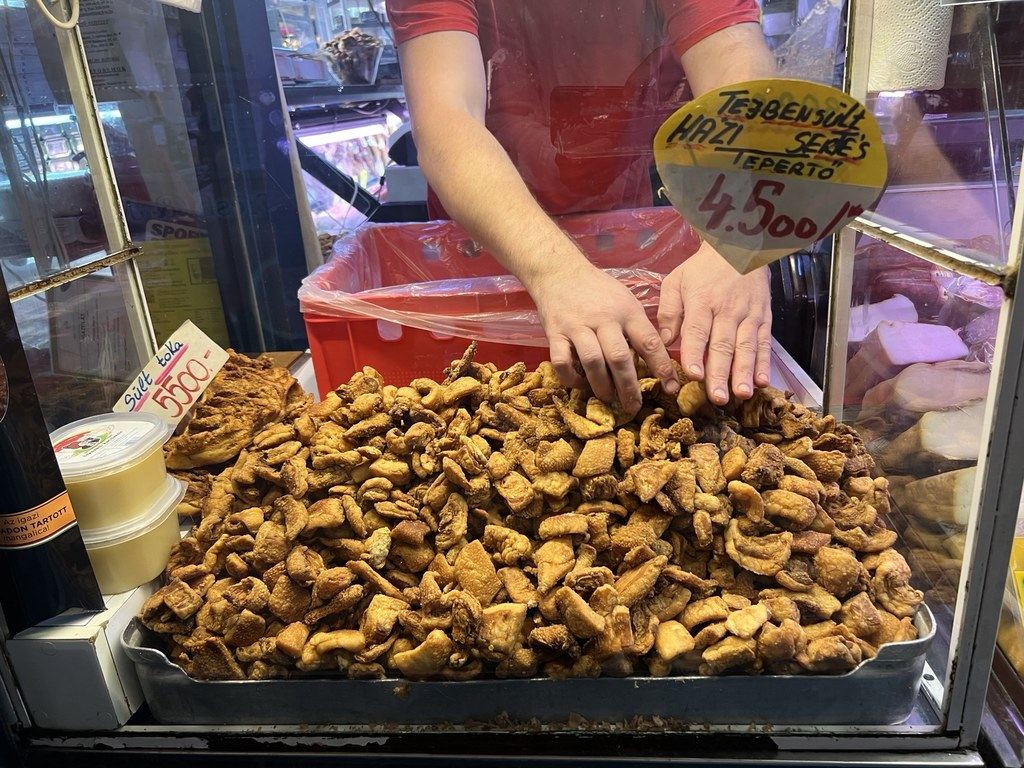
For our taste, this is a small snack to share. A squeeze of lemon or lime is what we would try next time; it is a pairing suggestion prompted by the richness, rather than something served with our order. We would also be more tempted by a little bowl alongside a beer than by a large bag eaten on its own.
Pastries, produce and the butcher stalls
There is plenty to browse beyond salami. We looked at cheese, olives, fruit and vegetables; peaches caught our attention, too. At the bakery counter, rows of curved pastries were marked with different fillings, including poppy seed and poppy seed with dried plum.

Goose-liver and truffle products also appeared among the foods we noticed. With these, we would compare ingredients, weight and storage needs before being swayed by the packaging.
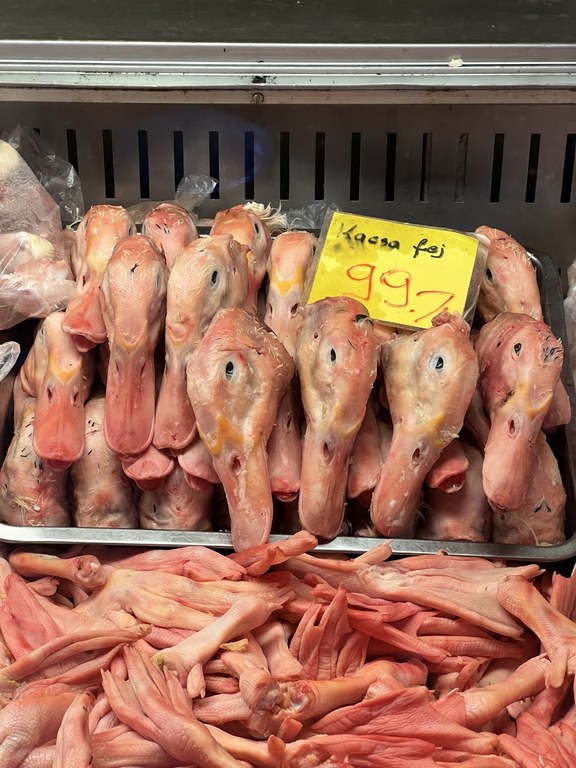
The butcher displays bring you back to the working market: cuts of meat, offal and poultry products all share the same building. One of our photographs shows duck heads and poultry feet. This was part of the range we found as we moved from packaged charcuterie to fresh-food counters.
Look up: the market hall itself
Before settling into the shopping, take in the roof. The high ceiling, metal structure and upper-floor railings made this feel like one of the largest food markets we had visited in Europe. From upstairs, we could see the stalls spread out below and appreciate the scale more clearly.
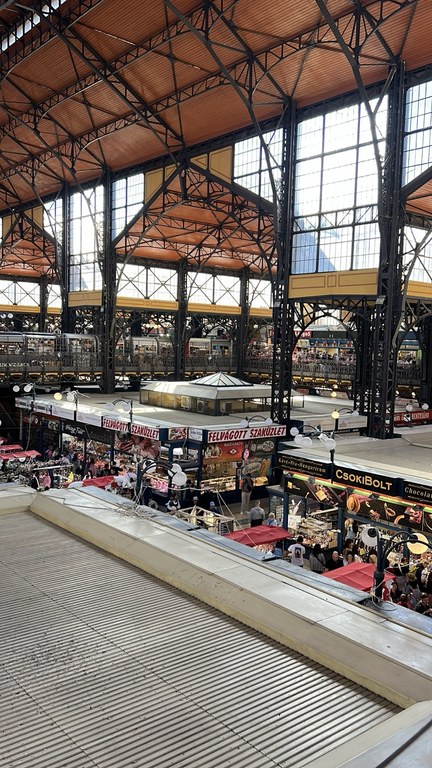
The hall was purpose-built for food trading. Designed by Samu Pecz, it began trading in 1897; its structural metalwork and Zsolnay ceramics are part of its architectural character. The building suffered serious damage during the Second World War and underwent restoration between 1991 and 1994. The market’s official history traces its development.
What we liked was seeing daily shopping continue beneath all that architecture. We could have stayed for hours moving between the displays.
Prices: pay attention to the unit
These are two labels from our September 2026 visit, useful as examples of how products were priced:
| Product photographed | Label price | Unit |
|---|---|---|
| Winter salami | 4,500 HUF | Per piece; net weight not verified |
| Paprika pork cracklings | 999 HUF | Per 100 grams |
HUF and Ft both mean Hungarian forints. Compare the same weight when looking between stalls, and check whether the price is per piece, per 100 grams or per kilogram. These recorded labels are not current price promises. We paid for our own food and shopping on the trip.
Where to eat near Central Market Hall
For a sit-down Hungarian meal nearby, see our Pipa Étterem review. We liked the crisp duck skin and cabbage-and-potato side, while the meat was firmer than we wanted.
For a nearby lángos stop, we went to Krumplis Lángos on Váci utca. We ordered a classic with garlic, sour cream and cheese, plus a version with sausage and red onion. Krumplis is a separate shop near the market.
For breakfast around Kálvin tér, Bageri on Ráday utca was our coffee-and-croissant find. Farther along Váci utca, Pichler served us warm chimney cakes baked after ordering.
These stops work as options around a market visit: coffee first, browsing next, then a meal or sweet if you have room. Our Budapest food guide brings together the rest of our trip, including Pipa Étterem nearby.
Address, opening hours and getting there
Central Market Hall / Great Market Hall / Nagyvásárcsarnok
Vámház körút 1–3, 1093 Budapest, Hungary.
The hall is beside Corvinus University, around Fővám tér. The official visitor page lists metro M4 and tram connections including lines 2, 47 and 49. Entry is free.
Opening hours checked on October 11, 2026: Monday–Friday 6 am–6 pm; Saturday 6 am–4 pm; Sunday 10 am–4 pm. The operator states that the hall closes on public holidays. Check the official market page for updates before visiting.
Get directions to Central Market Hall.
Frequently asked questions
Are Central Market Hall and Great Market Hall the same place?
Yes. Both names refer to Nagyvásárcsarnok at Vámház körút 1–3 in Budapest.
What would we buy first?
Paprika would be our first shelf to browse for something to use at home. Winter salami and kolbász would come next for a charcuterie-focused shopping trip.
Is it worth visiting without a shopping list?
Yes. The roof, the view from upstairs and the range of food displays made browsing worthwhile for us. We kept finding another counter we wanted to inspect.
How much time should you allow?
For food-focused browsing, we would leave a flexible couple of hours. That is a planning suggestion; you can make a shorter visit if you only want one or two products.
More Budapest food guides
- Budapest food guide — the places we visited and what we ordered.
- what to eat in Hungary — Hungarian dishes, sweets and food-shopping ideas.
- Best Lángos in Budapest — more addresses for fried dough with garlic, sour cream and cheese.
- Best Chimney Cake in Budapest — places to plan a sweet stop.



Pingback: Where to Eat in Budapest: 9 Places We Tried
Pingback: Pipa Étterem Budapest: Our Roast Duck Review